
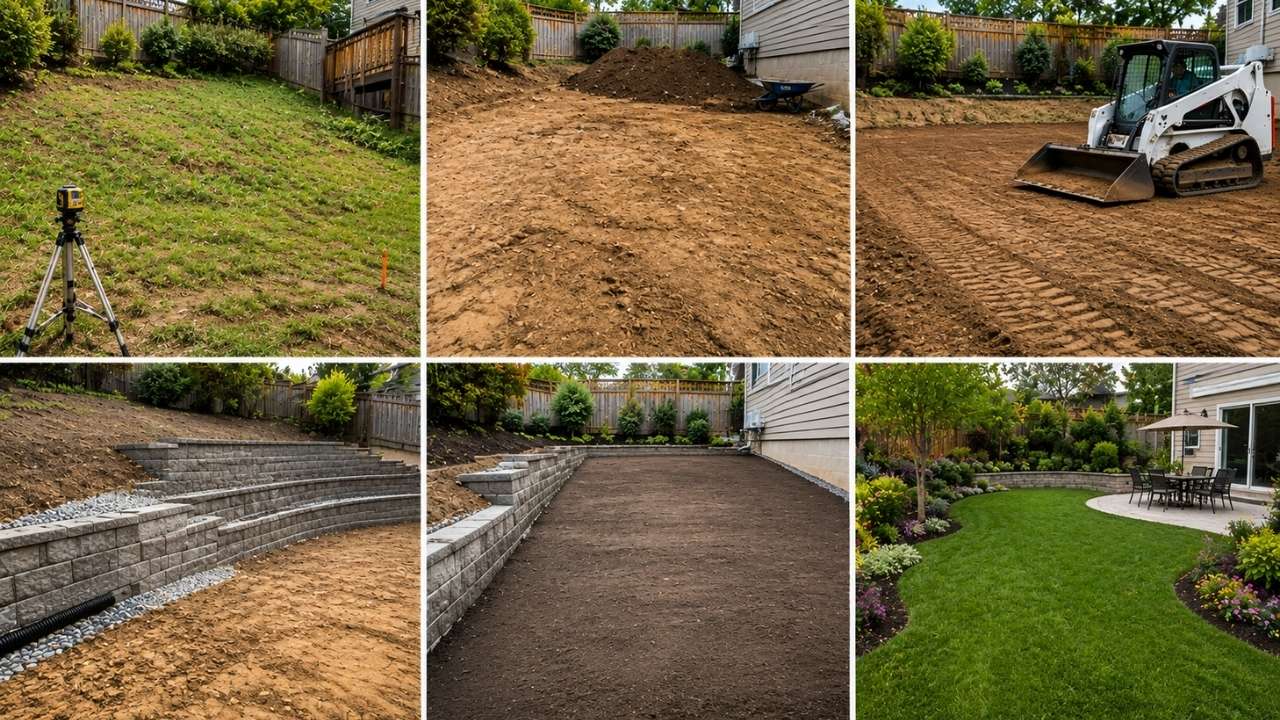
Your yard tilts. You want a flat spot for a table, a trampoline, or just grass that stops sliding toward the fence every spring. Fair enough. The catch is that flattening ground changes where rainwater goes, and water is patient. Move soil carelessly and you trade a slope for a soggy patch sitting against your foundation. Do it thoughtfully and the space finally works. Here is how to level a sloping backyard without ending up with a swamp.
Key Takeaways
- Water routing comes first, and the flat surface gets built around that decision.
- Ground closest to the house must keep falling away from the walls, no exceptions.
- Terracing usually beats one enormous cut once the drop passes a few feet.
- Strip and stockpile your topsoil before you touch the compacted layer underneath.
- Walls taller than about four feet pull permits and engineering into the project.
- Planted slopes hold their shape far better than bare graded soil ever will.
Watch the Water Before You Move Any Soil
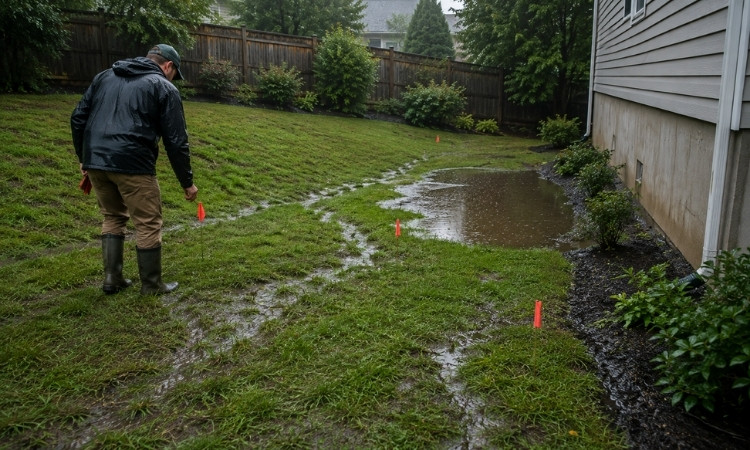
Everyone wants to start with a shovel. Start with a rainy afternoon instead. Walk the yard while it is actually pouring and note where water enters the property, where it pools, and where it leaves. Flag those spots. That five minute walk tells you more than any measurement will, because it shows you the path you are about to interrupt.
The one slope number worth memorizing
Ground next to your house needs to fall away from it. Guidance from the Building America Solution Center calls for permeable surfaces to drop at least half an inch per foot across the first ten feet, with backfill compacted so it does not settle later. That works out to roughly six inches over ten feet.
This Old House describes the same target as about a five percent grade, and stresses that consistency matters more than the exact figure, since water should always travel away from the foundation rather than toward it. Everything else in your project bends around this.
Measure the drop with string, not guesswork
Two stakes, a length of string, and a line level will tell you the real fall across your yard. Pull the string tight, level it, then measure the gap between string and ground at the low stake. Do it in three or four places. Yards are rarely one clean plane, and that variation is exactly what decides your approach.
Figure Out How Much Soil You Are Actually Moving
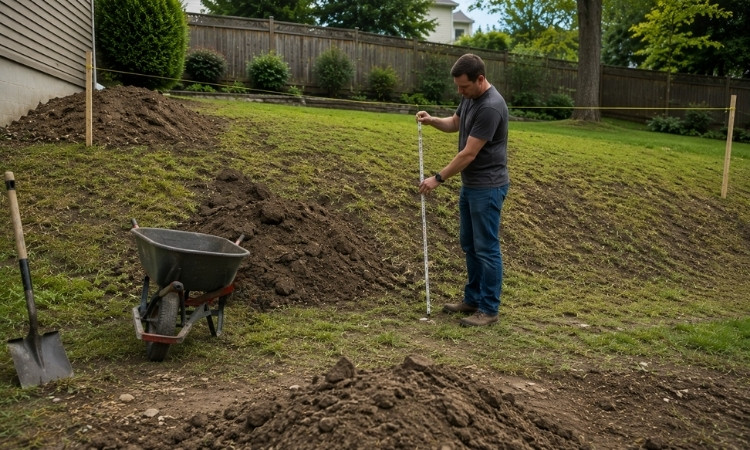
Here comes the part that surprises people. A modest looking slope can hide several cubic yards of soil. Before you level a sloping backyard, translate the drop into a rough volume, because that number decides whether this is a weekend with a wheelbarrow or a week with machinery.
Cut and fill, explained without the jargon
You take soil from the high end and place it at the low end. That is the whole idea. The complication is that filled soil settles, so it needs compacting in shallow layers rather than one heaped dump. Uncompacted fill looks perfect in May and turns into a puddle by October.
| Drop across the yard | What it usually means | Sensible approach |
| Under 1 foot over 20 feet | Cosmetic unevenness, not a grading problem | Topdress, rake smooth, overseed |
| 1 to 3 feet | Genuine grading work | Cut and fill, compact in layers |
| 3 to 6 feet | Too much for a single flat pad | Two or three terraces with low walls |
| Over 6 feet | Structural territory | Engineered walls, permits, professional help |
If your goal is a level pad for seating or cooking, size it honestly. A pad that fits the furniture and nothing more keeps the excavation small, which is also why a budget covered outdoor kitchen often lands on a modest platform rather than a fully flattened lawn.
Three Real Ways to Flatten the Ground
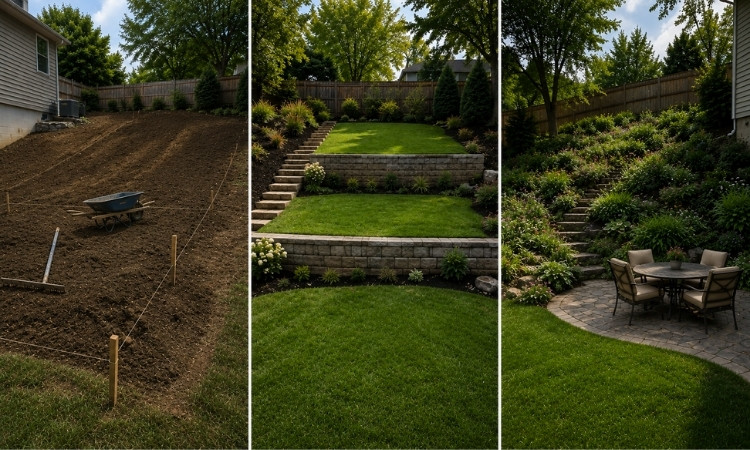
There is no single correct way to level a sloping backyard, only the one that suits your gradient and your patience. Each option below handles water differently, which is the part most people skip past.
Regrade the whole yard
Best for gentle slopes. You strip the topsoil, reshape the subsoil to your target grade, compact it, then spread the topsoil back over it. The finished surface still slopes slightly, just gently and in a direction you chose.
Terrace it into steps
Once the drop gets serious, terracing wins. The Snohomish County rainscaping guidance describes a terrace as a series of retaining walls creating level steps into a slope, which slows runoff so it can soak in, and recommends that each terraced bench be at least as wide as the wall holding it up.
Two waist high walls are almost always safer and cheaper than one tall one.
Level only the part you use
The quiet third option, and often the smartest. Flatten a single pad, leave the rest of the gradient alone, and plant it. Sloped ground reads beautifully when it is covered, and it costs a fraction of full regrading. Plenty of the best backyard garden ideas work with a gradient rather than fighting it.
Drainage Details That Keep You Out of Trouble
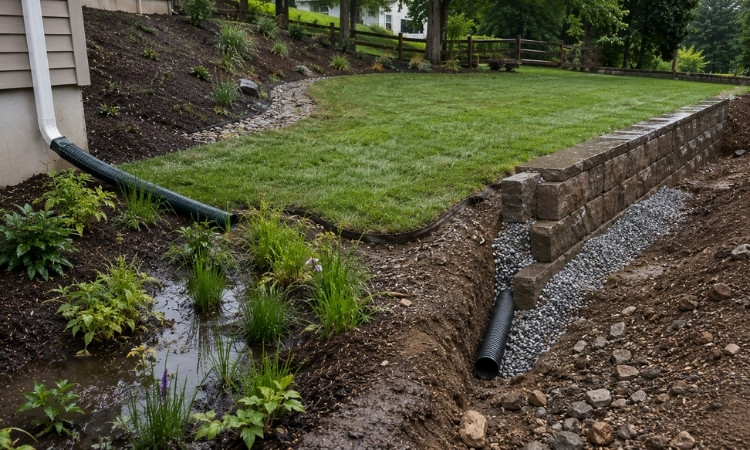
Flat ground does not absorb more water. It just holds it longer. So whenever you level a sloping backyard, build the exits before you build the surface.
- Extend downspouts well past the new flat area, never onto it.
- Keep a shallow swale along the uphill edge to intercept runoff before it arrives.
- Add gravel backfill and a perforated pipe behind any retaining wall.
- Give the finished pad a gentle fall of one to two percent toward the swale.
The EPA points to rain gardens as a practical way for homeowners to reduce polluted runoff coming off roofs, patios, lawns and driveways.
A planted low spot at the bottom of your yard is often the cleanest place to send everything you just redirected.
Permits, Property Lines and the Boring Paperwork
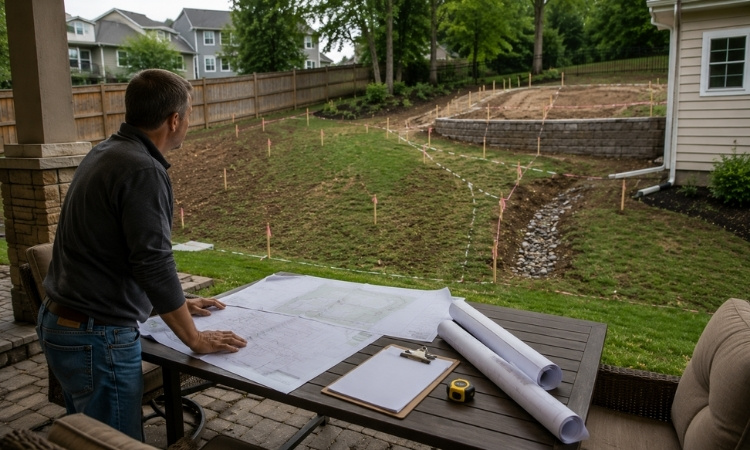
Grading changes drainage, and drainage crosses property lines, which is precisely why councils care. Retaining walls above roughly four feet in total height, or any wall carrying extra load behind it, typically need a permit and engineered plans. Rules vary by jurisdiction, so ask before you dig rather than after.
If the flat pad you create becomes a patio, your building department will want a scaled drawing showing the footprint, setbacks, and how surface water behaves once you level a sloping backyard.
Services such as Get A Site Plan site plans produce that kind of drawing from a property address, which spares you sketching one by hand. Check what your local office actually asks for first, since requirements differ from town to town.
Soil and Planting: Do Not Undo Your Own Work
View this post on Instagram
Graded soil is compacted soil, and compacted soil grows disappointing grass.
Oregon State University Extension recommends loosening soil to a depth of six to eight inches before grading and seeding, while warning that overtilling wrecks soil structure and leads to rapid recompaction. Loosen, level, seed, then leave it alone for a few weeks.
On the slopes you kept, roots are your insurance policy. RHS advice notes that sloping ground is prone to erosion, which makes it a hard place for roots to establish, and that choosing plants suited to those conditions reduces the need for extra watering once they settle in.
Spreading, deep rooted species do the structural work. A few of the top plants for a biophilic environment double nicely as slope binders.
FAQ
How much does it cost to level a sloping backyard?
Cost tracks soil volume and access more than anything else. A small hand graded pad on a gentle slope is inexpensive. Terracing with engineered walls sits in a completely different bracket. Get quotes based on your measured drop, not a general estimate.
Can I level a sloping backyard by hand?
Yes, on gentle slopes and small areas. A shovel, a wheelbarrow, a rake and a tamper will handle a mild gradient. Once you are moving more than a few cubic yards, hand work stops being realistic.
Will levelling cause water to pool?
Only if you flatten without planning an exit. Keep a slight fall on the finished surface and give runoff somewhere to go, and pooling is not an issue.
Is levelling safe for a kids play area?
It works well, provided the surface drains. Many families flatten one zone specifically so they can turn a backyard into a retreat for kids while leaving the rest planted.
Do I need a permit just for grading?
Sometimes. Larger volumes of moved soil and any work near a slope or waterway often trigger a grading permit. One phone call settles it.
Wrapping Up
The projects that go wrong are the ones that treat flat ground as the goal. It is not. The goal is a yard that stays dry, holds its shape, and does what you want it to do. Measure the fall, protect the route water takes, work in steps if the drop is steep, and put plants back into the soil when you are finished. Do that and you will level a sloping backyard once, properly, instead of fixing it every spring.